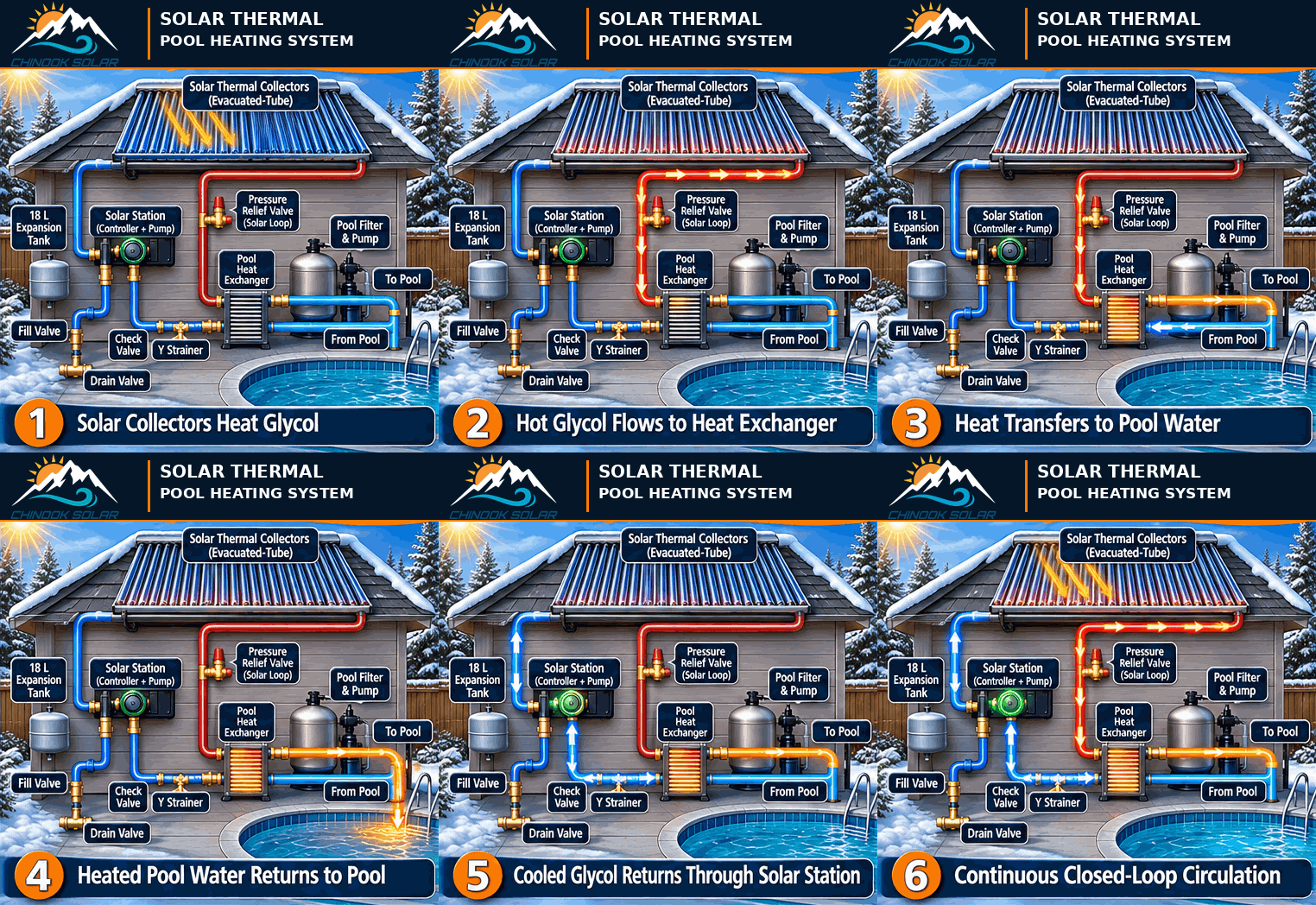
1. Capture solar heat
Sunlight heats the evacuated-tube collectors and the fluid circulating through their manifold. This is thermal energy, not photovoltaic electricity.

SOLAR THERMAL APPLICATION / SWIMMING POOLS
Solar thermal collectors gather energy from sunlight as heat, helping extend a swimming season without making electricity. In a typical indirect closed-loop design, circulating heat-transfer fluid passes through an exchanger that warms separately circulating pool water.
This diagram shows a conceptual swimming-pool application. Exact piping, component selection and winterization depend on the installer and site.
See the animated flow ↓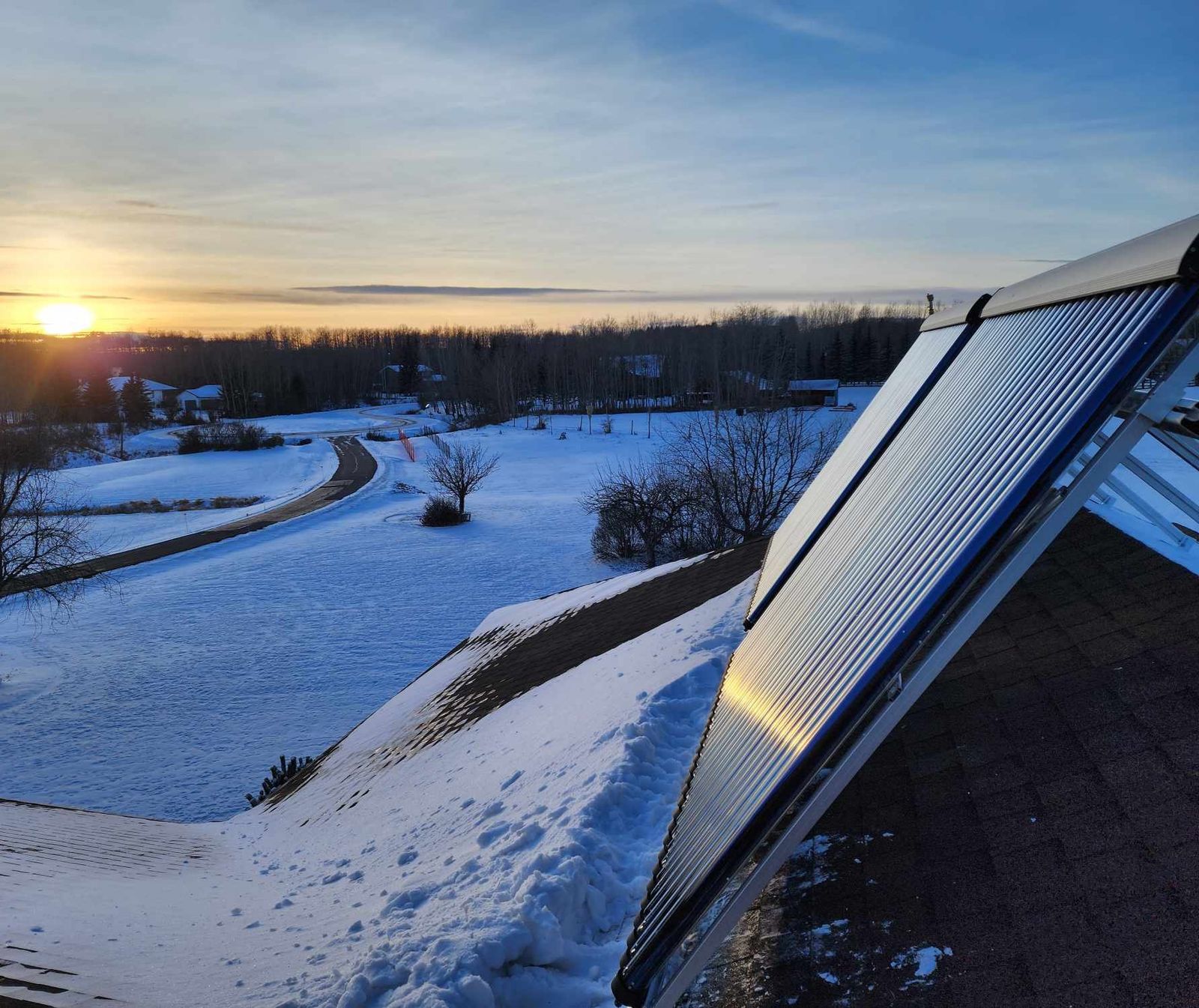
ANIMATED SYSTEM EXPLANATION
The red and blue collector pipes form their own circulation loop. Pool water passes through a different pair of exchanger connections. Energy crosses the heat-exchanger walls; the two fluids do not mix.
Animated educational schematic. Not a sealed-construction diagram or claim that every pool needs the same pump, valves, or antifreeze arrangement.
HOW A SOLAR THERMAL POOL HEATER OPERATES
Sunlight heats the evacuated-tube collectors and the fluid circulating through their manifold. This is thermal energy, not photovoltaic electricity.
Hot solar fluid travels toward the solar side of a properly selected heat exchanger. A pressure-relief device, controls and protection equipment form part of a safe engineered system.
The pool pump and filter circulate water through the pool side of the exchanger. The two streams stay separated while heat passes across the exchanger surfaces.
Warmed, filtered pool water returns to the pool through its return fittings. Water continues circulating under the pool's filtration controls.
Cooled solar fluid leaves the exchanger, passes through appropriate check/strainer fittings and the solar pump, and returns to the collector inlet for reheating.
A differential temperature controller activates solar pumping only when useful heat is available. Freeze protection, isolation, draining and seasonal shutdown depend on the installed design.
SOLAR POOL HEATING QUESTIONS
Yes, when a suitable design matches the pool's volume, surface losses, desired swimming temperature and available sunlight. Cover use and swimming-season length strongly influence the load.
Not in an indirect two-loop system. The pool circulation and solar transfer fluid are isolated inside a suitable heat exchanger. Exchanger materials must be compatible with the water chemistry.
Evacuated tubes can collect heat in low outdoor temperatures with sufficient sunlight. Outdoor pools and seasonal plumbing still require freeze protection, winterizing and a system-specific safety plan.
Tube count alone does not establish heat output or pool suitability. Sizing requires tested collector performance, solar resource, pool surface area, evaporation and heat losses.