Collector insulation
The vacuum between glass surfaces helps reduce convection and conduction, so the collector loses less heat to cold outside air.
 CHINOOK SOLAR
UNDERSTAND THE TECHNOLOGY
Solar thermal uses sunlight to heat a working fluid, then transfers that heat into stored hot water. Instead of making electricity like solar panels, the system can help reduce the energy a home, business, or greenhouse needs for certain heating tasks.
It cannot heat every building by itself. The amount of usable heat depends on the sun, collector temperature, storage, installation design and the heating load.
See the six steps ↓Explore equipment ↗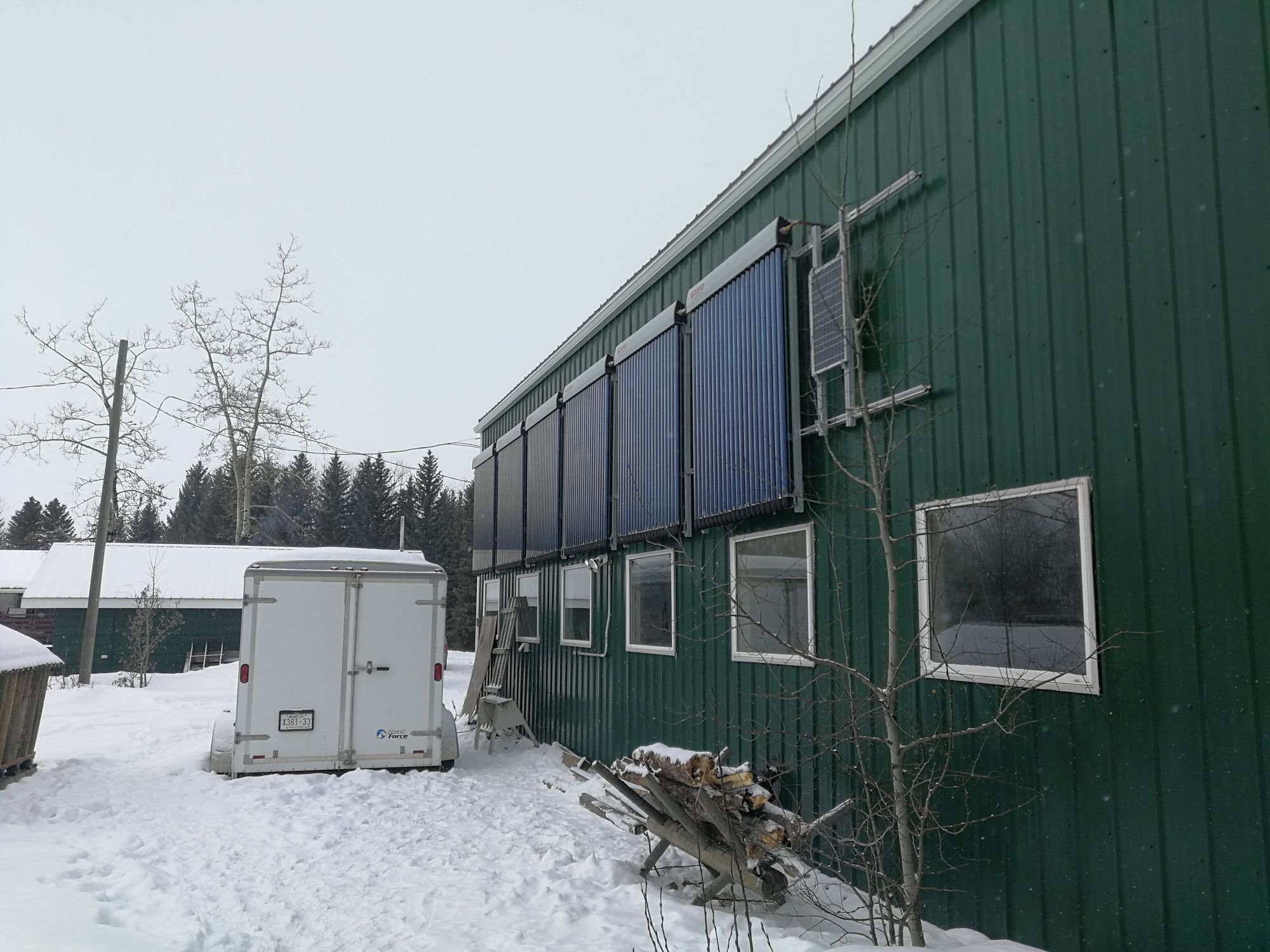
SOLAR EDUCATION / ALBERTA WINTER PERFORMANCE
Yes—evacuated-tube solar collectors can collect useful heat during very cold weather when sunlight is available. Natural Resources Canada notes that evacuated-tube collectors can work in temperatures as low as −40°C. The evacuated glass limits heat loss, helping the collector retain a temperature advantage even in freezing air.
But there is an essential distinction: a collector operating in −30°C air does not mean it can supply all the heating a home, barn, greenhouse, or shop needs during a −30°C cold snap. Complete-system performance depends on available winter sun, useful temperature, heat demand, storage, pump and controller operation, freeze protection, and a properly sized backup heat source.
CANADIAN CLIMATE REFERENCE
Natural Resources Canada identifies this as a temperature at which evacuated-tube collectors can work. It is not an independently verified lower operating limit or guaranteed heat-output rating for Chinook's specific 30-tube model.
Read Natural Resources Canada's solar water-heating guidance ↗The vacuum between glass surfaces helps reduce convection and conduction, so the collector loses less heat to cold outside air.
A sunny winter day can provide useful collector heat; shorter days, clouds, shade, snow coverage and low sun angles reduce available solar energy.
An engineered indirect loop typically uses a suitable antifreeze fluid and heat exchanger. Exposed piping, sensors and controls also require correct design.
An insulated tank stores solar heat for later use. A backup boiler or other heat source meets demand when solar contribution is insufficient.
For Alberta, design around the building’s cold-weather heat loss and the solar contribution the system can reliably deliver. A Chinook model-specific −40°C test report or measured winter solar fraction has not been verified; tube count alone does not establish winter output.
VISUAL EXPLANATION / CLOSED-LOOP SOLAR THERMAL
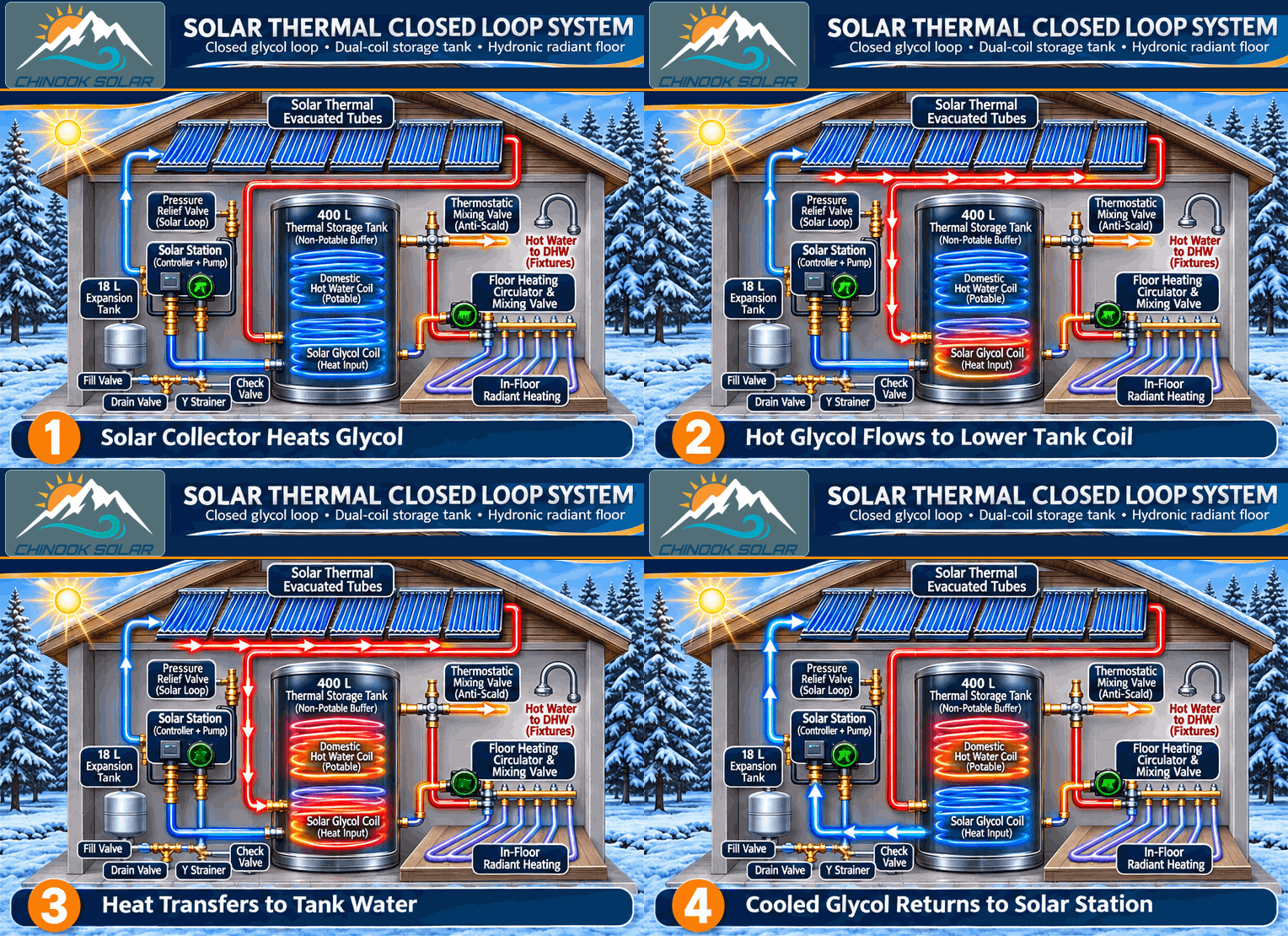
Hot solar glycol moves from the evacuated-tube manifold to the upper inlet of the storage tank's lower internal solar coil. It cools as it transfers heat into storage and leaves the coil's lower outlet before returning through the solar circulator to the collector. Domestic hot-water and in-floor heating have separate connections.
FIRST, TWO DIFFERENT TECHNOLOGIES
PV panels generate electricity to power lights, appliances, pumps or other electrical loads. Electricity may be stored in batteries or exchanged with the grid depending on the system.
Thermal collectors capture heat for transfer through a hydraulic system into a hot-water tank or compatible heating circuit. They are designed for heat demand, not electricity generation.
THE HEATING JOURNEY
The following describes a typical heat-pipe, indirect closed-loop solar thermal arrangement designed for freezing climates. Specific collector construction and equipment differ by model.
Solar radiation reaches the dark absorber surface inside each evacuated tube.
Air is removed between glass layers to reduce heat loss, like a thermos flask.
In a heat-pipe collector, heat moves up a sealed internal heat pipe toward the manifold.
The condenser transfers thermal energy into the fluid flowing through the insulated manifold.
A controller operates the circuit when the collector can usefully heat the storage tank.
Stored thermal energy assists domestic hot water or compatible heating. A backup source meets unmet demand.
An appropriately selected non-freezing solar heat-transfer fluid can circulate through a heat exchanger; household potable water is kept in a separate loop in an indirect system.
CONCEPTUAL CUTAWAY / HEAT-PIPE COLLECTOR
The key idea is simple: the glass admits sunlight, an absorber captures heat, a vacuum reduces heat loss, and an internal heat pipe brings the energy up into the manifold.
Diagram illustrates typical heat-pipe evacuated-tube principles. It is not a scale drawing or a verified Chinook manufacturing cross-section.
Lets light in while providing the sealed tube structure.
Reduces conductive and convective heat loss to cold outdoor air.
Converts incoming sunlight into useful heat within the collector.
Carries energy to the condenser near the manifold in this collector design.
Transfers energy to a separately controlled solar heat-transfer circuit.
INSIDE AN EVACUATED TUBE
A vacuum helps keep collected heat from escaping into cold outside air. In a heat-pipe style collector, energy travels toward a metal condenser at the top of the tube, which passes heat into an insulated manifold.
The educational cross-section below labels the principles. It is a text-based schematic—not a scale manufacturing drawing of Chinook's exact tube or manifold.
Examine the 30-tube model ↗Incoming solar radiation warms a selective absorber coating.
The transparent outer glass admits sunlight.
The vacuum reduces conductive and convective heat loss.
The selective surface converts light to heat and reduces thermal re-radiation.
A sealed working fluid transports heat toward a condenser at the tube top.
An insulated header transfers useful energy into the separate solar circulation circuit.
HEAT OUTPUT EXPLAINED
A quantity of thermal energy.
A rate of thermal energy transfer, not an amount of heat stored.
Power—a rate of output. 1 kW ≈ 3,412 BTU/hour.
Energy over a period. 1 kWh ≈ 3,412 BTU.
Illustrative water-heating calculation starting at 10°C and ending at 50°C, using 4.186 kJ per kilogram per °C and approximately 1 kg per litre. Figures exclude tank, piping and heat-exchanger losses. These are water-heating requirements, not measured Chinook collector output ratings.
| Water volume | Temperature rise | Energy needed | Equivalent thermal energy |
|---|---|---|---|
| 100 L | 10°C → 50°C | 4.65 kWh | ≈ 15,900 BTU |
| 200 L | 10°C → 50°C | 9.30 kWh | ≈ 31,700 BTU |
| 300 L | 10°C → 50°C | 13.95 kWh | ≈ 47,600 BTU |
CANADIAN WINTER CONDITIONS
Evacuated-tube collectors can capture heat in cold weather when solar radiation is available. But winter days are shorter, loads can be higher and some days offer little solar energy. A dependable design accounts for freeze protection, suitable controls, storage and backup heating.
The evacuated glass reduces heat loss at the collector.
Hydronic system components require correct fluid, pressure relief, expansion and control strategies.
A conventional or other suitable heat source serves demand beyond available solar heat.
Reference: Natural Resources Canada — Solar water heaters.
PRACTICAL APPLICATIONS
Preheat water for domestic use, with conventional backup.
Support compatible hydronic applications when building loads, storage and controls justify it.
Assist water-based heat distribution with storage and reliable backup.
Assess repeatable hot-water demand and the value of heat-offset rather than electricity production.
Examples of historical Chinook installations are available in the Projects guide. Older published capacity and output figures need confirmation against the project’s equipment records.
REAL INSTALLATIONS · ALBERTA CLIMATE
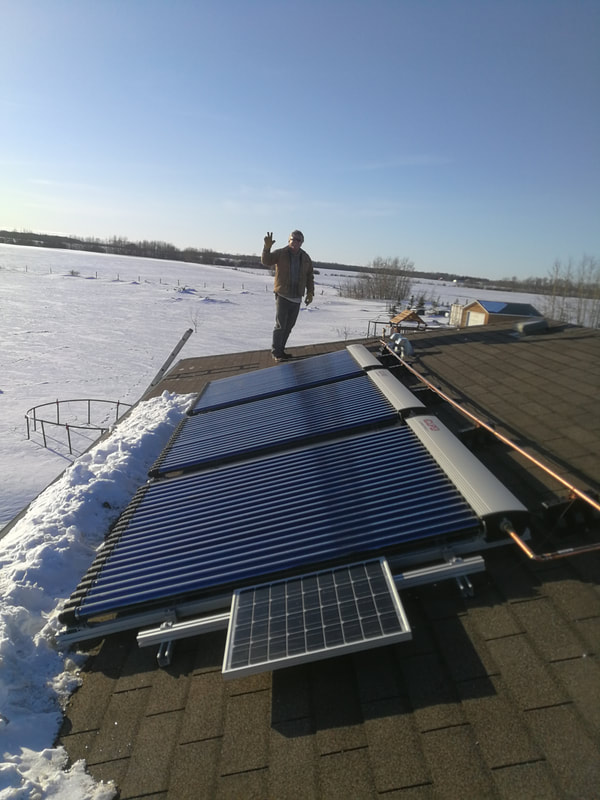
These photographs from the older Chinook/Off Grid Heating archive illustrate wall-mounted solar thermal collectors and a snow-covered roof-mounted evacuated-tube system. They show the equipment’s placement, but photographs alone do not establish annual output or certify a particular temperature rating.
Design details to assess: mounting angle, winter shading, piping insulation, heat-transfer fluid, storage and backup heat.
Understand the collector ↗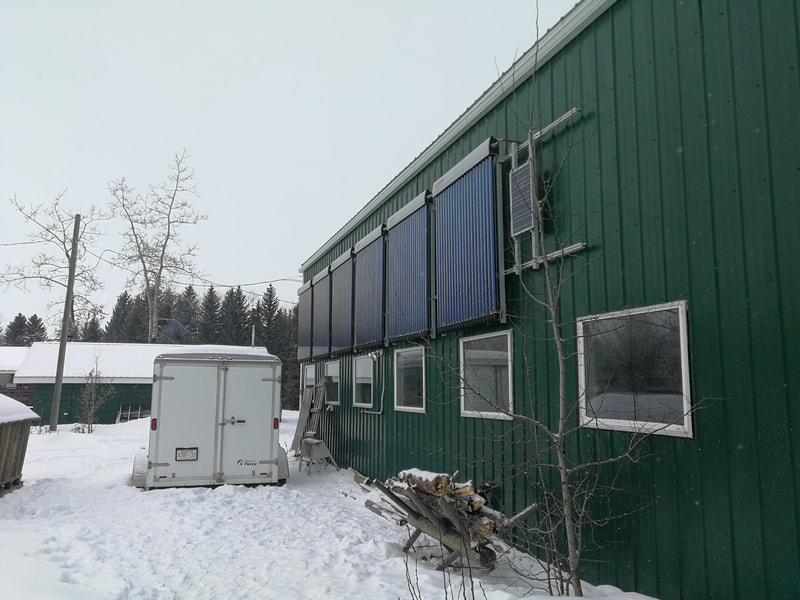
CHINOOK SOLAR EDUCATION CENTRE
New to solar thermal in Alberta? These practical answers explain how evacuated tubes capture heat, what a 30-tube collector can and cannot promise, how winter protection works, and what to consider before designing hot-water, farm, shop or greenhouse heating.
Solar thermal basics
Solar thermal heating uses sunlight to make useful heat instead of electricity. In a common Canadian system, an evacuated-tube collector heats a separate circulation fluid. A heat exchanger then transfers energy into a hot-water tank, which may help with domestic hot water or compatible water-based heating.
Solar photovoltaic (PV) panels make electricity. Solar thermal collectors gather heat. Both can be valuable, but equipment selection depends on whether a property needs electricity, hot water, hydronic space heating, or a combination.
Sunlight enters through the glass and is absorbed by a dark selective coating. A vacuum gap reduces heat loss. In heat-pipe designs, thermal energy moves toward a condenser at the top of the tube, then transfers into an insulated manifold.
The collector gathers sunlight without electrical power, but active systems generally use electricity for pumps, sensors and controllers. An off-grid arrangement needs a suitably sized power source for those components.
Solar collectors need sunlight to gather new energy. An insulated storage tank may hold heat from earlier in the day, and a conventional or other suitable backup heater maintains hot-water service when storage is insufficient.
Alberta winter
Evacuated-tube solar collectors can capture useful heat during very cold sunny weather. Natural Resources Canada says this collector technology can work in air as cold as −40°C. The actual useful heat depends on sunlight, temperatures, collector design, flow, storage and system controls.
Not automatically. A building's design heat loss and temperature requirements must be compared with expected winter solar generation and usable storage. Many systems supplement an appropriately sized boiler or other backup; complete reliance on solar requires site-specific proof.
In much of Canada, an indirect closed-loop design uses appropriately rated antifreeze heat-transfer fluid and a heat exchanger. Pipes, pump stations, expansion vessels and controls must also be designed and maintained for freezing conditions.
Collectors may capture some diffuse sunlight, but useful output declines when sunlight is weak. Snow covering the tubes, shading, short days and high required water temperatures can limit heat collection. Winter performance must be modeled, not assumed.
There are winter nights, cloudy stretches and periods when heating demand exceeds the collector's output. A backup boiler, water heater or other suitable heat source keeps the building or hot-water supply dependable.
BTU and sizing
There is no universal 30-tube BTU/hour rating. Power depends on the exact tested collector, incoming sunlight, fluid temperatures and heat losses. A verified output rating requires manufacturer performance data for the matching model.
kW and BTU/hour measure power or the rate of heat delivery. kWh and BTU describe energy accumulated over time. One kW is about 3,412 BTU/hour, while one kWh contains about 3,412 BTU of energy.
Raising 300 litres of water from 10°C to 50°C requires approximately 13.95 kWh, or 47,600 BTU, before heat losses. This is the water's energy requirement, not a claim about how quickly one solar collector can supply it.
Sizing starts with actual daily hot-water use or building heat loss, desired solar contribution, required water temperature, sunlight, storage and usable collector mounting area. Tube count alone cannot determine a suitable system.
No. A coating's ability to absorb incoming radiation is not the same as collector or whole-system efficiency. Useful heat depends on temperature differences, thermal losses, flow and system design. The manufacturer's tested thermal power curve is the relevant basis.
Cost and applications
Cost depends on collectors, support structure, pipework, insulation, pumps, controls, freeze protection, heat exchangers, hot-water storage, electrical work and integration labor. A collector-only price is not a complete installed-system quote.
A solar preheat or supplemental heating circuit can sometimes be integrated through appropriate storage, heat exchangers and controls. Existing boiler requirements, safe temperatures and summer heat management must be considered.
They can contribute heat to compatible water-based systems where temperatures, storage and demand align. Greenhouses require heat-loss calculations, seasonal planning and reliable backup for long cold periods.
It may reduce energy purchased for heating where a suitable system delivers useful heat. Real savings depend on measured or conservatively modeled output, the displaced heater's efficiency, fuel rates, seasonal demand and maintenance costs.
Maintenance may include checking heat-transfer fluid condition, pressure, pumps, sensors, expansion vessels, relief valves, insulation, leaks and collector mounting. The specific manufacturer's instructions and competent local service practices govern inspection intervals.
Begin with your building and energy use. Technical suitability comes before the size of the collector.